Twenty things I wish I’d known when I started my PhD


Starting a PhD can be tough. Looking back, there are many things I wish I’d known at the beginning. Here, I have curated a list of advice from current PhD students and postdoctoral researchers from the Department of Zoology at my institution, the University of Oxford, UK, to aid new graduate students.

1. Maintain a healthy work–life balance by finding a routine that works for you. It’s better to develop a good balance and work steadily throughout your programme than to work intensively and burn out. Looking after yourself is key to success.

2. Discuss expectations with your supervisor. Everyone works differently. Make sure you know your needs and communicate them to your supervisor early on, so you can work productively together.

3. Invest time in literature reviews. These reviews, both before and after data collection, help you to develop your research aims and conclusions.

4. Decide on your goals early. Look at your departmental guidelines and then establish clear PhD aims or questions on the basis of your thesis requirements. Goals can change later, but a clear plan will help you to maintain focus.

5. “I don’t need to write that down, I’ll remember it” is the biggest lie you can tell yourself! Write down everything you do — even if it doesn’t work. This includes meeting notes, method details, code annotations, among other things.

6. Organize your work and workspace. In particular, make sure to use meaningful labels, so you know what and where things are. Organizing early will save you time later on.

7. It’s never too early to start writing your thesis. Write and show your work to your supervisor as you go — even if you don’t end up using your early work, it’s good practice and a way to get ideas organized in your head.

8. Break your thesis down into SMART (specific, measurable, attainable, relevant and timely) goals. You will be more productive if your to-do list reads “draft first paragraph of the results” rather than “write chapter 1”. Many small actions lead to one complete thesis.

9. The best thesis is a finished thesis. No matter how much time you spend perfecting your first draft, your work will come back covered in corrections, and you will go through more drafts before you submit your final version. Send your drafts to your supervisor sooner rather than later.

10. Be honest with your supervisor. Let them know if you don’t understand something, if you’ve messed up an experiment or if they forgot to give you feedback. The more honest you are, the better your relationship will be. Helping your supervisor to help you is key.

11. Back up your work! You can avoid many tears by doing this at least weekly.

12. Socialize with your lab group and other students. It’s a great way to discuss PhD experiences, get advice and help, improve your research and make friends.

13. Attend departmental seminars and lab-group meetings, even (or especially) when the topic is not your area of expertise. What you learn could change the direction of your research and career. Regular attendance will also be noticed.

14. Present your research. This can be at lab-group meetings, conferences and so on. Presenting can be scary, but it gets easier as you practise, and it’s a fantastic way to network and get feedback at the same time.

15. Aim to publish your research. It might not work out, but drafting articles and submitting them to journals is a great way to learn new skills and enhance your CV.

16. Have a life outside work. Although your lab group is like your work family, it’s great for your mental health to be able to escape work. This could be through sport, clubs, hobbies, holidays or spending time with friends.

17. Don’t compare yourself with others. Your PhD is an opportunity to conduct original research that reveals new information. As such, all PhD programmes are different. You just need to do what works for you and your project.

18. The nature of research means that things will not always go according to plan. This does not mean you are a bad student. Keep calm, take a break and then carry on. Experiments that fail can still be written up as part of a successful PhD.

19. Never struggle on your own. Talk to other students and have frank discussions with your supervisor. There’s no shame in asking for help. You are not alone.

20. Enjoy your PhD! It can be tough, and there will be days when you wish you had a ‘normal’ job, but PhDs are full of wonderful experiences and give you the opportunity to work on something that fascinates you. Celebrate your successes and enjoy yourself.


source: doi: 10.1038/d41586-018-07332-x

Ongkos Hidup di Taiwan

Berikut secara umum biaya hidup di Taipei, Taiwan. Taiwan menggunakan New Taiwan Dollar (NTD/TWD) sebagai mata uang yang bila dikonversikan sekitar 400-an Rupiah untuk 1 NTD. Untuk biaya hidup sehari-hari, secara sederhana dibagi menjadi tiga yaitu tempat tinggal, makan, dan transportasi.

1. Tempat Tinggal
Sebagian besar universitas di Taiwan menyediakan asrama untuk mahasiswanya. Keuntungan terbesar tinggal di asrama adalah efisiensi pengeluaran, rata-rata biaya tinggal di asrama adalah 8.000-12.000 NTD atau sekitar 3 sampai 5 Juta Rupiah per semesternya (setiap empat bulan), bentuk asrama bervariasi, ada yang satu kamar diisi dua sampai enam orang, tergantung kebijakan masing-masing universitas. Selain murah, keuntungan tinggal di asrama adalah sosialisasi dengan mahasiswa lokal dan internasional, serta fasilitas seperti internet, mesin cuci, kamar mandi, dan vending machine yang bisa ditemukan di asrama.
Selain asrama juga bisa kost menyewa satu kamar untuk jangka waktu tertentu dengan kisaran harga sekitar 4000-8000 NTD perbulan juga bisa tinggal di apartemen dengan sewa berkisar 20.000 NTD per bulan dan bisa sharing dengan teman2 lain.

 
2. Makan
Untuk makan bisa memasak sendiri atau membeli di tempat makan. Memang sebagian besar asrama di kampus Taiwan tidak mengizinkan untuk memasak dalam asrama terkait keamanan. Namun tidak perlu khawatir, banyak warung Taiwan yang ramah dengan kantong mahasiswa. Bagi mahasiswa muslim, warung vegetarian menjadi alternatif cerdas, selain sehat, murah (harga 30-70 NTD / mulai Rp. 13ribuan per porsinya) dan pasti halal.
Bila rindu masakan Indonesia, jangan khawatir, ada banyak toko Indonesia seantero Taiwan. Selain menjual beragam produk seperti mie instan, bumbu masakan, camilan, dan produk sehari-hari juga makanan khas nusantara seperti nasi goreng, sate, mie ayam, dan bakso dengan harga sekitar 70-150 NTD per porsinya.

 
3. Transportasi Kota
Sistem transportasi di Taiwan saat ini dikenal sebagai salah satu yang terbaik di Asia, ada beragam moda transportasi umum yang dapat pembaca nikmati di sini, seperti sepeda umum, bus kota, MRT.
Ongkos bus variatif dari 5 sampai 15 NTD setiap satu kali naik bisa keliling kota. Sedang MRT bisa ditemui di Taipei dan Kaohsiung. Tiket MRT dihitung berdasaekan stasiun yang dilalui, dengan tarif dimulai dari 20 NTD. Selalu bawa kartu mahasiswa kemanapun pergi di Taiwan untuk potongan harga tiket.

Knowledge sharing behavior and quality among workers of academic institutions in Indonesia

Authors: Saide, Trialih, R., Wei, H.L., Anugrah, W.  


While studies have highlighted the importance of knowledge sharing in organizations to help improve performance, there is still a difficulty among workers to share knowledge due to the fear of losing valuable knowledge. In this article, we present a study investigating factors that influence knowledge sharing among workers of academic institutions, specifically aiming to develop a deeper understanding of knowledge sharing practices and quality of knowledge shared. While most studies relating to aspects of knowledge management are concerned with the service industries, academic institutions have not received much attention, especially in Indonesia. We validated our measures and tested our research model using 337 respondents. We conclude that soft and hard rewards, communication skills, and enjoyment to help others are key factors that influence knowledge sharing behavior. Finally, recommendations and implications are discussed to help institutions guide their efforts to build knowledge sharing strategies.


Full Article: https://www.scopus.com/record/display.uri?eid=2-s2.0-85036536984&origin=resultslist&sort=plf-f&src=s&sid=1be4936e138fe098819727d1ed98af3c&sot=autdocs&sdt=autdocs&sl=18&s=AU-ID%2857188873069%29&relpos=4&citeCnt=1&searchTerm=  


Saide Saide received the bachelor’s degree with the Department of Information System, Faculty of Science and Technology, Universitas Islam Negeri Sultan Syarif Kasim Riau-UIN SUSKA Riau, Indonesia, in 2013, the master’s degree from the Department of Information Management, National Taiwan University of Science and Technology, Taipei, Taiwan, in 2016, and the master’s degree from the Departmentof Information System, Sepuluh Nopember Instituteof Technology (ITS Surabaya), Surabaya, Indonesia, in 2016, all in information systems and knowledge management. He is currently a Lecturer with the Department of Information System, Facultyof Science and Technology, Universitas Islam Negeri Sultan Syarif Kasim Riau - UIN SUSKA Riau. He was a Visiting Scholar and Research Collaboration withTampere University, Finland, a Researcher with the Department of Information Management, National Taiwan University of Science and Technology, a Project Management with EnReach - Energy Research Center, UIN SUSKA Riau, Indonesia. He has authored numerous articles published in SSCI/SCI journals such as Big Data, Technology Analysis & Strategic Management, IEEE Transactions on Engineering Management, and Journal of Enterprise Information Management, International Journal of Innovation Management, Journal of Science and Technology Policy Management, and International Journal of Business and Society. His research interests include knowledge management, information system, and IT-business strategy.


Sosial Media nya Akademisi / Researcher / Authors


Menarik melihat perkembangan sosial media (facebook, twitter, instagram, dll) disemua lini kehidupan. Beberapa nya menggunakan sosial media sebagai wadah untuk saling berkomunikasi satu dengan lain, mempertemukan dengan teman-teman lama lewat dunia maya, juga sebagai wadah komersil untuk jual beli online.

Singkatnya, hari ini, kaum millenials juga idealnya mulai memaksimalkan sosial media bentuk lain, saya sebut "sosial media nya researcher/forum ilmiah" untuk mendongkrak study mereka. Sosial media tersebut seperti ResearchGate, Mendelay, GoogleScholar, ORCIDid, OSF, dll.
Berikut link sosial media tersebut:

Mendelay: https://www.mendeley.com/
sekilas panduan: https://drive.google.com/file/d/13K8ZOiAIZuuCIVsLO3lL4DWdt12mem1E/view?usp=sharing

DOWNLOAD MENDELEY:
WINDOWS: https://www.mendeley.com/download-desktop/Windows/
macOS: https://www.mendeley.com/download-desktop/

Berikut materi Mendeley presentasi saya di beberapa seminar :https://drive.google.com/file/d/106dUjdX95WKa5vN2gz4HCVlNl6mo65_a/view?usp=sharing

GoogleScholar: https://scholar.google.com.tw/schhp?hl=en
sekilas panduan: https://drive.google.com/file/d/19k_OEIoTCygcCRb0aN0GsuM1txoI4ZZW/view?usp=sharing

ORCIDid: https://orcid.org/
sekilas panduan: https://drive.google.com/file/d/1TCe54uBbFSRMeji_jX_i33bryiTXRDPI/view?usp=sharing

OSF: https://osf.io/register/
sekilas panduan: https://drive.google.com/file/d/1cQhrcAr-NciCbIB5uKX51F2G7_WV2Y7F/view?usp=sharing


ResearchGate: https://www.researchgate.net/

ResearcherID: http://www.researcherid.com/Home.action

SCOPUS: https://www.scopus.com/customer/profile/display.uri

Mudah-mudahan bermanfaat untuk kemaslahan umat.

Beasiswa Spring Semester 2019 di Kampus-Kampus Taiwan.

Buat para scholarship hunters yang ingin melanjutkan pendidikan di Taiwan, berikut PPI Taiwan lampirkan informasi beberapa universitas yang sudah membuka pendaftaran untuk Spring Semester 2019.

Sekilas mengenai beasiswa universitas, terdapat 3 jenis beasiswa yang ditawarkan setiap universitas dan setiap universitas mempunyai kebijakannya masing-masing yaitu:
1. Full Scholarship, beasiswa ini meliputi bebas uang kuliah dan mendapatkan uang saku.
2. Partial Scholarship, beasiswa ini meliputi bebas uang kuliah dan mendapatkan uang saku yang nominalnya lebih kecil dari penerima full scholarship.
3. Tuition Waiver, beasiswa ini hanya meliputi bebas uang kuliah dan tidak mendapatkan uang saku.
Persiapkan aplikasi kalian dari sekarang dan selamat berjuang. Karena kata Nelson Mandela, “Education is the most powerful weapon which you can use to change the world”


Universitas
Link Scholarship
Pendaftaran online
National Taipei University of Technology
National Taiwan Normal University
Tamkang University
National Taiwan University of Science and technology
National Central University
National Chiao Tung University
National Taipei University of Education
National Cheng Kung University
National TsingHua University
National Sun-Yat Zen University
National Taiwan Ocean University
Dayeh University
http://fa.dyu.edu.tw/english/student2.html


 sumber: https://ppitaiwan.org/2018/07/09/beasiswa-spring-semester-2019/ 
file word: https://ppitaiwan.org/wp-content/uploads/2018/07/Beasiswa-Taiwan-Spring-Semester-2019.docx

BEASISWA MOFA TAIWAN


Program beasiswa Taiwan merupakan beasiswa yang diiniasisi bersama oleh Kementerian Luar Negeri (MOFA), Kementerian Pendidikan (MOE), Kementerian Urusan Ekonomi (MOEA) dan Dewan Sains Nasional (NSC). Program beasiswa ini pertama kali diluncurkan pada tahun 2004. Pada tahun 2011, program beasiswa ini berkembang menjadi program Beasiswa MOFA Taiwan dan program Beasiswa MOE Taiwan yang bertujuan untuk memberikan kesempatan para pelajar dari berbagai latar belakang bidang studi untuk dapat menempuh pendidikan di Taiwan.

Program beasiswa MOFA merupakan beasiswa yang bertujuan untuk mendorong para pelajar yang memiliki prestasi akademik untuk meraih gelar akademiknya di Taiwan. Beasiswa ini juga menjadi sarana untuk membangun persahabatan dan peningkatan pertukaran budaya antara pelajar Taiwan dengan pelajar dari negara-negara lain.

Para pelajar dari negara yang memiliki hubungan diplomatik dengan Taiwan memiliki kesempatan besar untuk memperoleh beasiswa ini. Namun beasiswa ini juga memberikan kesempatan bagi para pelajar dari negara-negara yang belum memiliki hubungan diplomatik dengan Taiwan.

Program
1. The non-degree Mandarin Language Enrichment Program (LEP)
Penerima beasiswa akan mengambil LEP maksimum 1 tahun pada institusi pengajar mandarin (Mandarin Training Centers) yang bekerja sama dengan universitas atau fakultas yang terakreditasi oleh Kementerian Pendidikan Taiwan.
2. Degree programs
Penerima beasiswa diperbolehkan untuk mendaftar pada bidang ilmu apapun untuk jenjang studi S1, S2 atau S3.
Durasi Beasiswa
a. Non-degree LEP: 1 tahun.
b. Degree programs:
  1.  Program S1: 4 tahun maksimum
  2. Program S2: 2 tahun maksimum
  3. Program S3: 4 tahun maksimum
Bantuan Dana Pendidikan
Untuk mendukung kelancaran studi, penerima beasiswa akan diberikan bantuan dana pendidikan yang diberikan meliputi sebagai berikut:
1.  Uang saku sebesar NTD 25.000 untuk LEP.
2. Uang saku sebesar NTD 30.000 untuk degree program.
3. Tiket pesawat ekonomi untuk keberangkatan 1 arah dengan tujuan ke dan dari Taiwan.
Persyaratan Pendaftar
Pelamar beasiswa harus memenuhi ketentuan sebagai berikut:
  1. Memiliki nilai akademik yang bagus, moral dan karakter yang bagus, serta tidak ada catatan kriminal.
  2. Tidak termasuk kenegaraan Republic of China (ROC) Taiwan.
  3. Tidak termasuk salah satu bagian dari kenegaraan China
  4. Tidak pernah menerima pendidikan disalah satu institusi di Taiwan pada tingkat yang sama atau LEP yang yang ingin di daftar.
  5. Bukan termasuk siswa pertukaran melalui perjanjian kerja sama antara universitas / perguruan tinggi asing dan lembaga pendidikan di Taiwan saat menerima beasiswa.
  6. Sebelumnya tidak memiliki beasiswa yang dicabut oleh lembaga pemerintah ROC atau lembaga terkait lainnya.
Hal lainnya
  1. Untuk informasi lebih lanjut, hubungi Taiwan Scholarships and Huayu Enrichment Scholarships website at https://taiwanscholarship.moe.gov.tw/
  2. MOFA website: http://www.mofa.gov.tw/
  3. Contact person: Yi-Ching Chuang
  4. https://ppitaiwan.org/2018/06/18/beasiswa-mofa-taiwan/ 
Tel: +886-2-2236-8225 ext.4210,4211 or 4212
Fax: +886-2-2236-8593
Emai1: ivanc@cc.shu.edu.tw
Periode Pendaftaran
Periode pendaftaran beasiswa pada tanggal 1 Februari 1 sampai 31 Maret.

Knowledge Management Support for Enterprise Resource Planning Implementation

Authors: Saide and Mahendrawathi


This study addresses the issues of Enterprise Resource Planning (ERP), Knowledge Management (KM) and SECI model (socialization, externalization, combination, internalization). Various research have highlighted the importance of knowledge of ERP users for successful ERP implementation, however a major obstacle from the perspective of integration or knowledge transfer cycle still exists. The main problem in ERP implementation is the difficult integration of tacit (embedded) and explicit knowledge cause most of this knowledge are embedded in ERP external parties (such as consultants, vendors, suppliers, supervisors, experts, and other working partners). The focus of this study is to propose process for transfer knowledge from external organizations into organizations based on the model of SECI. To note that this paper is not to modify the basic model of SECI, but SECI model to making as a function of mediator between the external and internal ERP system implementation in company. The authors used a systematic literature review approach, starts with literature review, problems identification, selection process, assess, synthesize and write down the ideas proposed, and then make conclusions. Finally, the output of this research is a new model (schematic and technical) of the process and transfer knowledge order to maintain and re-use assets from external knowledge obtained during the pre to post ERP implementation to be used jointly by the company.

Full article: https://www.sciencedirect.com/science/article/pii/S1877050915036315  
 
 
Saide Saide received the bachelor’s degree with the Department of Information System, Faculty of Science and Technology, Universitas Islam Negeri Sultan Syarif Kasim Riau-UIN SUSKA Riau, Indonesia, in 2013, the master’s degree from the Department of Information Management, National Taiwan University of Science and Technology, Taipei, Taiwan, in 2016, and the master’s degree from the Departmentof Information System, Sepuluh Nopember Instituteof Technology (ITS Surabaya), Surabaya, Indonesia, in 2016, all in information systems and knowledge management. He is currently a Lecturer with the Department of Information System, Facultyof Science and Technology, Universitas Islam Negeri Sultan Syarif Kasim Riau - UIN SUSKA Riau. He was a Visiting Scholar and Research Collaboration withTampere University, Finland, a Researcher with the Department of Information Management, National Taiwan University of Science and Technology, a Project Management with EnReach - Energy Research Center, UIN SUSKA Riau, Indonesia. He has authored numerous articles published in SSCI/SCI journals such as Big Data, Technology Analysis & Strategic Management, IEEE Transactions on Engineering Management, and Journal of Enterprise Information Management, International Journal of Innovation Management, Journal of Science and Technology Policy Management, and International Journal of Business and Society. His research interests include knowledge management, information system, and IT-business strategy.

Literature Reviews and the Review Process: An Editor-in-Chief’s Perspective

This article orginally written by Murray E. Jennex (2015)

Here I just highlight the main keywords of this article. Lamb (2013) defines the literature review as a review of secondary sources documented in text that considers the critical points of current knowledge, including substantive findings and theoretical and methodological contributions to a particular topic. 

The University of Arizona (2011) notes that the literature review has two purposes. The first is to justify the review by showing there are gaps of knowledge that are worthy of closer investigation, that the contribution is original, that the research has been approached in a rigorous manner, and whether existing research contradicts or supports the research approach. The second is to develop an argument by showing an understanding of the critical literature, identifying issues, and framing the research into what is known, what remains to be learned, and how the research will contribute. Dennis and Valacich (2001) summarize the literature review’s purpose as identifying theory that can be used to explain findings and conduct the research. Dennis and Valachich (2001) also identify the top two ways of getting rejected by a quality journal as avoiding theory in favor of summarizing prior research and omitting key papers from the literature review. As such, as these sources indicate, the literature review is more than just summarizes the literature—it also frames the research in theory. This is important to understand because it shows that the literature review is a very important part of research and not just something that we are required to do.

What impacts the quality of literature reviews? I have reviewed many reviews and offer the following observed reasons that I’ve deduced from the reviewer comments to answer this question:
1. Literature reviews of convenience: these literature reviews are usually done by authors who do not have immediate access to all the relevant papers. I commonly observed such papers occur when a paper’s literature review contained papers from only one or a few relevant journals, usually the open access journals or those journals available through online repositories. Authors commonly respond to this issue by saying that their university cannot pay for access.
2. Weak search criteria: these literature reviews are usually done by authors who want to ensure that they are doing new work. I commonly observed such papers occur with students and new/junior
academics/researchers and with search criteria that were not consistent with the logical breakdown of the subject being examined (e.g., using partial ontology such as knowledge transfer and not associated terms such as knowledge flow or knowledge sharing, or using new names for constructs that already have agreed- on ontology such as a knowledge management repository system rather than the common term knowledge management system).
3. Artificial search criteria: these literature reviews are usually done by authors who want to limit the number of papers they need to include in the literature review. I have observed such papers in several cases with no discernable pattern for its use. These literature reviews are characterized by constrained search criteria (examples include search criteria that only look at journals in the AIS Senior Scholar basket, search criteria that are regionally constrained such as search criteria that only look for papers in South Africa papers written in a language other than the language of the journal such as Chinese, or search criteria that only look at quantitative papers instead of also qualitative papers that use quantitative measures).
4. Not going to the source: these literature reviews are done by authors who may not know better than to use original papers or who do not have access to them. This is rapidly becoming a major issue due to the open source movement and the Internet. Reviewers who understand seminal works and key concepts typically identify this issue. These literature reviews cite a paper that cites another paper instead of finding the source document (e.g., an example would be citing Jennex (xxxx) for a point made by Alavi and Leidner (xxxx) because the author has the Jennex paper but not the Alavi and Leidner paper). This issue is potentially the most damaging because it causes authors to not build on the existing body of knowledge and can potentially damage colleagues by not giving the appropriate credit where it is due. The issue is becoming more prevalent due to authors citing Wikipedia instead of the source citation, authors citing an edited book’s editor instead of the chapter’s author, or authors who cite an open source paper instead of the cited source in the document. I suspect that this could also be an issue with journals in other languages due to translation errors or lack of knowledge on how to cite properly by the translator.
5. Not understanding the source: these literature reviews usually do a good job of summarizing the literature but fail to synthesize it or, even worse, incorrectly synthesize the knowledge in the source. Reasons for these literature misinterpretations vary and many may be due to translation issues for non-native English speakers. Of course there are other literature review issues but the above five account for the vast majority that I have seen.

I recommend that editors should:
- Not burden reviewers with reviewing unacceptable or low-quality literature reviews: desk reject the paper and explain what it is expected for the literature review to the author(s). 
- Assist authors in finding appropriate literature from their journal and encourage reviewers to suggest their own papers if they are relevant as Jennex (2009) suggests.
- Be aware of the journals in their field so that they can ensure authors are covering them. 
- Do not automatically accept the reasons of the practical screen (Okoli & Schabram, 2010) for limiting literature reviews. Require authors to explain why applying the practical screen is acceptable and ensure reviewers concur.
- Include guidance and best practice for performing literature reviews in the guide to authors. 
- Include standards and expectations for literature reviews in the guide to authors.

Lastly, I recommend that reviewers should:
- Not perform the literature review for the author: it is okay to tell the author to do their job. 
- Understand the ontology of the field and ensure that the methodology used to perform the literature review is appropriate.
- If authors are applying a practical screen, ensure that the reasons used to justify it are reasonable and acceptable.
- Recommend a strategy for doing the literature review when there are significant issues with it. 
- Recommend your own work when it is relevant; build the body of knowledge as per Jennex (2009). - Ensure the critical papers in the field are reviewed as appropriate (Dennis & Valachich, 2001). 
- Ensure that authors synthesize the literature and demonstrate correct understanding of it; expect more than a summary of papers (Dennis & Valachich, 2001).
- Not consider the literature review as just something that needs to be done: it is an important part of research and ultimately the goal is to further the body of knowledge.

source:  http://aisel.aisnet.org/cais/vol36/iss1/8

How to Select a Research Topic

Selecting a Topic

The ability to develop a good research topic is an important skill. An instructor may assign you a specific topic, but most often instructors require you to select your own topic of interest. When deciding on a topic, there are a few things that you will need to do:
  • brainstorm for ideas
  • choose a topic that will enable you to read and understand the literature
  • ensure that the topic is manageable and that material is available
  • make a list of key words
  • be flexible
  • define your topic as a focused research question
  • research and read more about your topic
  • formulate a thesis statement
Be aware that selecting a good topic may not be easy. It must be narrow and focused enough to be interesting, yet broad enough to find adequate information. Before selecting your topic, make sure you know what your final project should look like. Each class or instructor will likely require a different format or style of research project.
Use the steps below to guide you through the process of selecting a research topic.

Step 1: Brainstorm for ideas

Choose a topic that interests you. Use the following questions to help generate topic ideas.
  • Do you have a strong opinion on a current social or political controversy
  • Did you read or see a news story recently that has piqued your interest or made you angry or anxious?
  • Do you have a personal issue, problem or interest that you would like to know more about?
  • Do you have a research paper due for a class this semester?
  • Is there an aspect of a class that you are interested in learning more about?
Look at some of the following topically oriented Web sites and research sites for ideas.

  • Are you interested in current events, government, politics or the social sciences?
    • Try Washington File
  • Are you interested in health or medicine?
    • Look in Healthfinder.gov, Health & Wellness Resource Center or the National Library of Medicine
  • Are you interested in the Humanities; art, literature, music?
    • Browse links from the National Endowment for the Humanities
  • For other subject areas try:
    • the Scout Report or the New York Times/ College Web site
Write down any key words or concepts that may be of interest to you. Could these terms help be used to form a more focused research topic?
Be aware of overused ideas when deciding a topic. You may wish to avoid topics such as, abortion, gun control, teen pregnancy, or suicide unless you feel you have a unique approach to the topic. Ask the instructor for ideas if you feel you are stuck or need additional guidance.

Step 2: Read General Background Information

  • Read a general encyclopedia article on the top two or three topics you are considering. Reading a broad summary enables you to get an overview of the topic and see how your idea relates to broader, narrower, and related issues. It also provides a great source for finding words commonly used to describe the topic. These keywords may be very useful to your later research. If you cant find an article on your topic, try using broader terms and ask for help from a librarian.
For example, the Encyclopedia Britannica Online (or the printed version of this encyclopedia, in Thompson Library's Reference Collection on Reference Table 1) may not have an article on Social and Political Implications of Jackie Robinsons Breaking of the Color Barrier in Major League Baseball but there will be articles on baseball history and on Jackie Robinson.
Browse the Encyclopedia Americana for information on your topic ideas. Notice that both online encyclopedias provide links to magazine articles and Web sites. These are listed in the left or the right margins.
  • Use periodical indexes to scan current magazine, journal or newspaper articles on your topic. Ask a librarian if they can help you to browse articles on your topics of interest.
  • Use Web search engines. Google and Bing are currently considered to be two of the best search engines to find web sites on the topic.

Step 3: Focus on Your Topic

Keep it manageable
A topic will be very difficult to research if it is too broad or narrow. One way to narrow a broad topic such as "the environment" is to limit your topic. Some common ways to limit a topic are:
  • by geographical area
Example: What environmental issues are most important in the Southwestern United States
  • by culture
Example: How does the environment fit into the Navajo world view?
  • by time frame:
Example: What are the most prominent environmental issues of the last 10 years?
  • by discipline
Example: How does environmental awareness effect business practices today?
  • by population group
Example: What are the effects of air pollution on senior citizens?
Remember that a topic may be too difficult to research if it is too:

  • locally confined - Topics this specific may only be covered in these (local) newspapers, if at all.
Example: What sources of pollution affect the Genesee County water supply?
  • recent - If a topic is quite recent, books or journal articles may not be available, but newspaper or magazine articles may. Also, Web sites related to the topic may or may not be available.
  • broadly interdisciplinary - You could be overwhelmed with superficial information.
Example: How can the environment contribute to the culture, politics and society of the Western states?
  • popular - You will only find very popular articles about some topics such as sports figures and high-profile celebrities and musicians.
If you have any difficulties or questions with focusing your topic,discuss the topic with your instructor, or with a librarian

Step 4: Make a List of Useful Keywords

Keep track of the words that are used to describe your topic.
  • Look for words that best describe your topic
  • Look for them in when reading encyclopedia articles and background and general information
  • Find broader and narrower terms, synonyms, key concepts for key words to widen your search capabilities
  • Make note of these words and use them later when searching databases and catalogs

Step 5: Be Flexible

It is common to modify your topic during the research process. You can never be sure of what you may find. You may find too much and need to narrow your focus, or too little and need to broaden your focus. This is a normal part of the research process. When researching, you may not wish to change your topic, but you may decide that some other aspect of the topic is more interesting or manageable.
Keep in mind the assigned length of the research paper, project, bibliography or other research assignment. Be aware of the depth of coverage needed and the due date. These important factors may help you decide how much and when you will modify your topic. You instructor will probably provide specific requirements, if not the table below may provide a rough guide:
Assigned Length of Research Paper or Project Suggested guidelines for approximate number and types of sources needed
1-2 page paper 2-3 magazine articles or Web sites
3-5 page paper 4-8 items, including book, articles (scholarly and/or popular) and Web sites
Annotated Bibliography 6-15 items including books, scholarly articles, Web sites and other items
10-15 page research paper 12-20 items, including books, scholarly articles, web sites and other items

Step 6: Define Your Topic as a Focused Research Question

You will often begin with a word, develop a more focused interest in an aspect of something relating to that word, then begin to have questions about the topic.
For example:
Ideas = Frank Lloyd Wright or modern architecture
Research Question = How has Frank Lloyd Wright influenced modern architecture?
Focused Research Question = What design principles used by Frank Lloyd Wright are common in contemporary homes?

Step 7: Research and Read More About Your Topic

Use the key words you have gathered to research in the catalog, article databases, and Internet search engines. Find more information to help you answer your research question.
You will need to do some research and reading before you select your final topic. Can you find enough information to answer your research question? Remember, selecting a topic is an important and complex part of the research process.

Step 8: Formulate a Thesis Statement

Write your topic as a thesis statement. This may be the answer to your research question and/or a way to clearly state the purpose of your research. Your thesis statement will usually be one or two sentences that states precisely what is to be answered, proven, or what you will inform your audience about your topic.
The development of a thesis assumes there is sufficient evidence to support the thesis statement.
For example, a thesis statement could be: Frank Lloyd Wright's design principles, including his use of ornamental detail and his sense of space and texture opened a new era of American architecture. His work has influenced contemporary residential design.
The title of your paper may not be exactly the same as your research question or your thesis statement, but the title should clearly convey the focus, purpose and meaning of your research.
For example, a title could be: Frank Lloyd Wright: Key Principles of Design For the Modern Home
Remember to follow any specific instructions from your instructor.

reference: https://www.umflint.edu/library/how-select-research-topic 

The Approaches to identify research gaps and generate research questions

First let’s start with a question: what is “research gap”? Research gap is a research question or problem which has not been answered appropriately or at all in a given field of study. Research gap is actually what makes your research publishable, why? Because it shows you are not just duplicating existing research; it shows you have a deep understanding of the status of the body of knowledge in your chosen field; and finally it shows that you have conducted a research which fulfills that gap in the literature.
Researchers, particularly those pursuing Master’s or PhD often find it difficult to identify the gaps in the body of knowledge in their own chosen fields. Identifying gaps and generating research questions can be regarded as the first and most important step in writing a research paper. Of course there are many approaches for overcoming this difficulty, but finding original and innovative topics, and distinguishing gaps in the literature is never an easy feat. There are different approaches to employ and not all researchers, especially younger ones, are aware of them. Here, we will try to briefly discuss them.
For starters, considering the gap finding issue, three classes of researchers can be distinguished:
  • The first class is mainly the class of researchers who act according to their personal enthusiasm. These researchers have complete proficiency in their chosen field which is the result of years of experience or a rich body of knowledge acquired after covering all the important papers in their field of study.
  • The second class is encouraged by peripheral factors. For instance, a researcher may choose a particular college and a certain professor. That professor might have a specific project in hand and he may suggest this project to you. The, you would investigate and if the project is close to your expectations for a masters or PhD degree, you will select it.
  • It is really the same story with the third group. Again a peripheral factor, this time not the professor, forces the researcher to select a topic. For instance, the environment the researcher has grown up in, and the needs of that environment, i.e. society, will force him to focus mostly, for example, on agricultural sector.
So far we have discussed three classes of researchers each of whom chooses a topic in a different way. But what if you are not knowledgeable in your field? What if you do not want to choose a topic based on your professor’s interest? What if environmental factors are not of importance for you? Well, there are other approaches you can use in order to find a gap, topic or a popular trend in your chosen field of study; some are simple and some other sophisticated:

  1. The easiest way would to read specific parts of the articles in your field of study. Of course there may be hundreds of articles in your field, but you have to find the most suitable ones by measuring their value and finding out how influential they are. After finding the most suitable articles (there are tools which can help you in this regard, but we are not discussing them here) you should examine the parts which include “introduction” section, which always has a sentence or two about the reasons why that research is done; “conclusion” section and of course “suggestions for future research” section in which the author of the article, having examined the literature and conducted a research himself, would point his readers to areas which lack investigation or need closer examination.

  1. One other approach is to read systematic reviews. These papers delve deep into the literature and examine the trends and changes in a discipline or specific field of study and provide summaries of the literature which can in some cases save a lot of research time. Moreover, content analysis reports, citation analysis reports and meta-analysis reports can be very illuminating and helpful, especially the later which reports the findings of the previous researches.


  1. Another approach is to visit the website of the most prominent and influential journals in your field of study. These journals often have a “Key Concepts” section which aims to assist the journal’s audience to develop an appreciation of central ideas in that field and to approach the content of articles from a perspective which is informed by present debate on aspects of both theory and practice. Key Concepts are usually very short articles and each one is dedicated to one specific topic. They are often written by well-known scholars who are expert in that field of study or topic. There is also a reference section in “Key Concept” papers which introduces the most important papers or books written about that topic.

  1. There is another type of paper which is called “State of the Art” paper. State of the Art papers summarize the state of knowledge on a specific subject. They delimit research frontiers and identify fruitful and promising areas of future research. They can be classified under systematic review papers.

Now the above mentioned were some general and rather simple approaches to finding gaps, research questions and topics. There are also tools and more sophisticated approaches which can save you research time and give you better overview of the current trends and areas of interests in your field of study:
  1. One of these tools is developed by Thomson Reuters; it is called “Essential Science Indicator”. Some universities have access to this website. If your college has provided you access to this website then you utilize it. It tells you about the most cited papers in each field, the new areas or branches that have been developing in that field. It also identifies the influential individuals, institutions, papers, publications, and countries in that field.

  1. You can also use “Google Trends” in order to find out if the popularity or interest in a topic is increasing or decreasing, you can also use this tool to compare various topics with each other and see which one is more popular. Google Trends also provides “regional interest” index; this piece of information shows which topic is hot or popular in which country. Another piece of information provided by Google Trends is “related searches” which provides queries similar to yours and the name of the authors who are active in the topic you have searched.
There are other websites and tools such as Social Mention, Springer, Google Ads, and BroadReader which provide more sophisticated information regarding the queries such as their popularity, various bars and charts which demonstrate the trends in different time spans, the most recent articles that have been downloaded and their related tags ad etc. You can find a more detailed discussion of these tools in the following mind map:
http://tcfex.com/research-tools-box-ale-ebrahim/
As you work with these tools and manipulate them you begin to understand how they work and which one is best for your field of study. But keep one thing in mind, try to use only one of them and master utilizing it. These tools can save you an enormous amount of research time and effort and open new doors in your life. Do not underestimate their value and start using them.

And, one more thing for professional researchers:
Well, here is a food for thought: what we discussed above was the conventional approaches to gap spotting and generating topics and research questions. However, there always other and new ways of approaching research questions. For instance, Alvesson and Sandberg state that although gap spotting is the prevalent way of constructing research questions, these “established ways of generating research questions rarely express more ambitious and systematic attempts to challenge the assumptions underlying existing theories” (Alvesson & Sandberg, 2011). Thus, they propose an alternative method:
Our aim in this study is to integrate the positive and the negative research agenda by developing and proposing problematization as a methodology for identifying and challenging assumptions that underlie existing theories and, based on that, generating research questions that lead to the development of more interesting and influential theories within management studies (Alvesson & Sandberg, 2011).

They have developed a typology of the type of assumptions that can be problematized in the existing theories and proposed a set of methodological principles to approach the problematization concept. Although appealing, the problematization method can be a bit risky, since it may involve challenging existing paradigms and their underpinning ontological and epistemological assumptions. In fact, Alvesson and Sandberg too mention that “challenging assumptions is often risky, since it means questioning existing power relations in a scientific field, which may result in upsetting colleagues, reviewers, and editors and, thus, may reduce the chances of having an article published” (Alvesson & Sandberg, 2011).
So if you dare, there can always be new ways of approaching research questions, although the method proposed by Alvesson and Sandberg may not, for obvious reasons(!), be suitable for young researchers at all and as all university professors tell their students, “don’t try to take on too ambitious projects at first”.


References
Alvesson, M., & Sandberg, J. (2011). GENERATING RESEARCH QUESTIONS THROUGH PROBLEMATIZATION. Academy of Management Review. doi:10.5465/AMR.2011.59330882

PRO-Knowledge Group ambil bagian di IEEE CONFERENCE, Singapura [berbagi cerita] (Indexed by Ei and Scopus)

     IEEE International Conference on Industrial Engineering and Engineering Management, nama lengkap dari konferensi ini. Tak ada perjuangan yang sia-sia, begitulah kata pepatah. Beberapa bulan bergulat memperjuangkan paper ini, akhirnya dipastikan paper kami layak untuk dipublish. Persiapan keberangkatan pun dimulai, semua persiapan mulai dari mengurus passport yang menjadi pengalaman pertama sampai pada perlengkapan harian yang dibutuhkan selama kegiatan konferensi berlangsung. Banyak hal yang tak bisa kami lakukan sendiri, dosen sekaligus pembimbing kami pak Saide memberikan banyak masukan dan bantuan untuk kesuksesan kegiatan ini. Beberapa kali berkumpul untuk merampungkan keberangkata hingga hari H pun datang.
       Kami berempat Azhiah, Putri Nadya dan Winda termasuk dosen kami Pak Saide bertolak ke Singapura pada Minggu 10 Desember 2017 dari Bandara Internasional Sultan Syarif Kasim II menuju Changi Internasional Airport, Singapore. Pesawat lepas landas pada jam 15.00, hanya sekitas 1 jam 30 menit, kami sampai dengan selamat di Singapura. Kami disambut dengan cuaca mendung hingga akhirnya hujan turun. Sesampainya di Bandara Changi, Singapura, 2 rekan research kami sudah menanti Rahmat Trialih (Kampus Brawijaya) dan Kartika (Kampus NTUST Taiwan).
        Beberapa tahap pemeriksaan di bagian imigrasi dilakukan. Beberapa menit setelahnya kami memutuskan untuk beristirahat sembari menunggu waktu shalat maghrib dan menunaikan shalat. Setelah energi kembali pulih, kami melanjutkan perjalan ke hotel tujuan kami, namun karena malam belum larut, kami singgah ke salah satu destinasi wisata yang popular di Singapura yaitu Garden By The Bay. Suasana malam sangat cocok untuk menikmati pemandangan yang dihiasi dengan lampu-lampu indah, puas menikmati pemandangan kami akhirnya melanjutkan perjalanan ke hotel.
         Sesampainya di hotel kami beres beres sedikit, menunaikan shalat dan beristirahat untuk bangun awal esok pagi. Karean tanggal 11 Desember adalah jadwal untuk mempersentasikan papar kami. Berada di negara yang kondisinya benar-benar berbeda dengan daerah asal kita menjadi kesenangan tersendiri. Banyak yang patut di contoh dari negara maju yang satu ini, satu dari beberapanya adalah kualitas transportasi umum yang sangat memanjakan pengguna.
        Pada hari kedua yaitu hari senin tanggal 11 desember 2017 kami menghadiri acara IEEM 2017 di singapura, acara pertama yaitu pembukaan yang di isi oleh dua orang keynote yaitu Bapak Andy Neely yang berasal dari University of Cambridge dengan judul materi “Rethinking Operations Stratetgy in an Age of Digital Manufacturing dan Bapak Bejamin W. WAH yang berasal dari The Chinese University of Hongkong dengan judul materi “Using Kernels To Harness The Complexity of Big Data. Cukup kaget ketika menginjakkan kaki memasuki ruangan utama seminar, hampir 300 peserta dari berbagai Negara ikut ambil bagian dalam event IEEE tahunan ini. Saat pertama kali masuk keruangan ini kami melihat penulis-penulis dunia dari berbagai Negara, tidak pernah tebayangkan oleh kami bisa sampai ada disini bertemu orang orang hebat yang luar biasa dan kebanyakan adalah professor, dosen, dan mahasiswa S2, hal ini membuat kami semakin semangat bahwa dunia ini luas masih banyak yang perlu di ketahui dan dipelajari, dan kami juga merasa bahwa ilmu yang kami miliki saat ini sangatlah sedikit, selama ini yang kami tau hanya kuliah belajar dan skripsi ternyata banyak ilmu di luar sana yang belum kami ketahui.
1
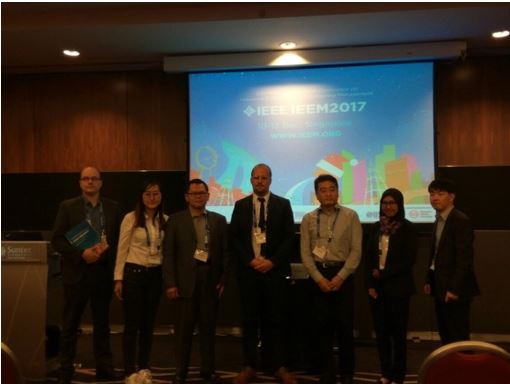
Foto Bersama Penulis Paper Dan Chairs IEEM

2
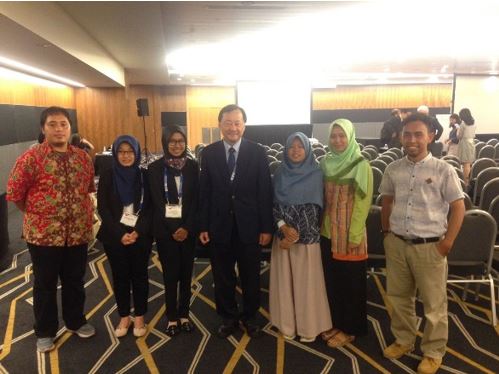
Foto Bersama Bapak Bejamin W. WAH
          Setelah pembukaan kami menghadiri beberapa presentasi dari penulis-penulis dunia yang sangat menarik dan sampai saatnya giliran kami untuk presentasi yang diwakilkan oleh salah satu teman kami yaitu Putri Nadya Fazri mahasiswi jurusan sistem informasi fakultas sains dan teknologi uin suska riau. Ini merupakan pengalaman pertama mempresentasikan sebuah penelitian di ajang kelas internasional yang dihadiri oleh orang-orang dari berbagai Negara, cukup menegangkan dan sangat sangat grogi dan Alhamdulillah presentasi berjalan lancer dan juga pertanyaan penguji dapat terjawab dengan baik. Dan yang kami salutkan mereka sangat menghargai apapun jawabannya dan juga mengapresiasi karena kami mahasiswi S1 bisa mengikuti seminar internasional ini. Ini adalah pengalaman yang sangat berharga bagi kami karna disini kami banyak bertemu orang-orang dari berbagai dunia berbagi ilmu dan pengalaman.
       Pada hari ketiga, niat nya kami pada hari ketiga akan berkunjung ke johor malaisya. namun planing itu kami batalkan karena kami merasa belum puas menikmati kota singapur dan kami mengubah jadwal untuk pergi kegedung kenferensi lagi untuk melihat kak kartika persentasi dan berniat untuk berfoto-foto dengan peserta dari negara lain. pada saat itu di meja copibreak kami berbincang dengan seseorang berasal dari negara (nurwegia) dan dia sangat salut kepada kami karena kami baru S1 sudah ikut ajang konferensi internasional.
       Lanjut pada siang harinya siap sholat zuhur dan makan malam kami berangkat untuk pergi mengunjungi universal studio, saat sedang menikmati suasana di universal studio hari hujan dan kami melanjutkan perjalan ke Merlion, kata orang kalau belum kesini belum ke Singapore. Setiba di Merlion hari hujan kami duduk-duduk sambil menunggu hujan reda. Tepat sore menjelang malam hujan pun reda barulah kami melihat keindahan patung singa yang dikelilingi lampu lampu dari gedung yang sangat indah.
3
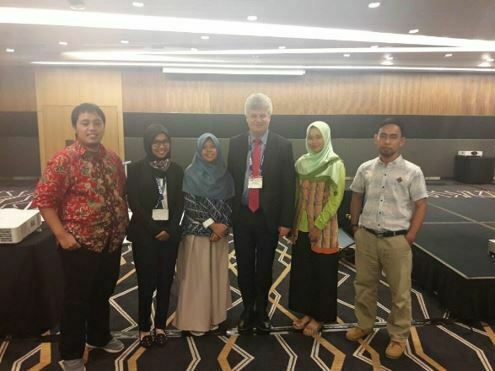
Foto Bersama Bapak Andy Neely
4

Terima kasih:
  • Prodi Sistem Informasi
  • Pro-Knowledge Group in Department of Information System, State Islamic University of Sultan Syarif Kasim Riau 28293, Indonesia.
  • Dompet Dhuafa.
  • Richardus Eko Indrajit; dan
  • Semua rekan/pihak yang terlibat mensukseskan keberangkatan kami.